
Reconstruction and Creative Development of Historical Relief Printing
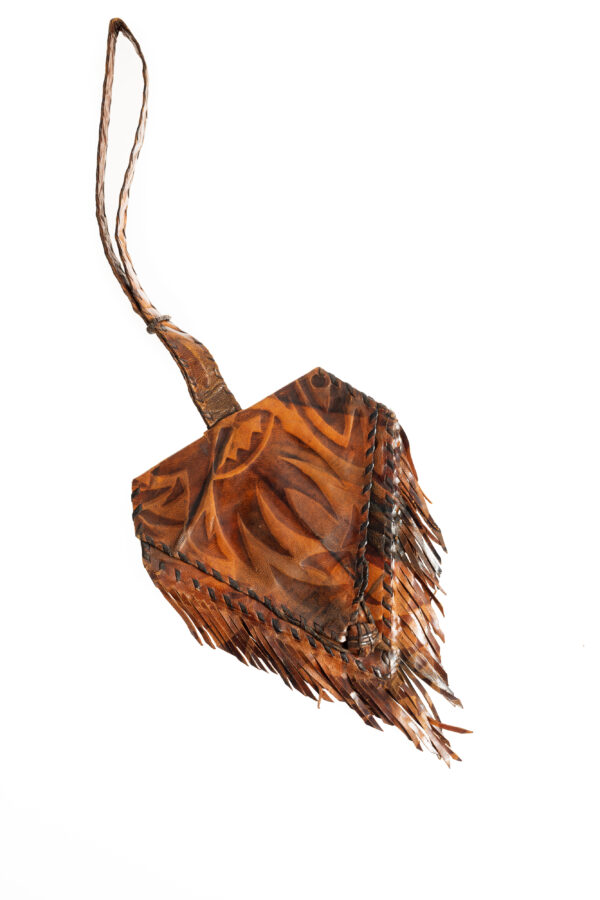
The starting point of the study was the relief printing technique used in Eduard Taska´s workshop in 1924, which was currently unknown but distinguished from the well-known cliché and linoprint by its two-dimensional result and the absence of fine graphic lines. Two leather handbags (AM 15737/1 and AM 15737/2) decorated in this technique from the Estonian History Museum’s textile collection have survived and allowed for closer examination.
The research aimed at reconstructing the relief printing process as authentically as possible and developing solutions suitable for contemporary materials and techniques based on the restored historical technique that allows for mass production.
Through experimentation, it was discovered that the relief print being studied was a reverse print. In conventional circumstances, a printing press pushes the printing plate against the right side of the material resting on the press base. In the case of reverse printing the printing plate is placed on the press base with the pattern facing upward, printed material is laid on top towards the printing plate, and the press, in contrast to the usual situation, presses the material against the printing plate.
The reverse print allows for the use of a wide range of reusable and recyclable materials as printing plates. It enables to blind and foil print on various materials. The results of the experiments show that the reverse print is suitable for prototyping as well as for the production of unique items and small-scale products.


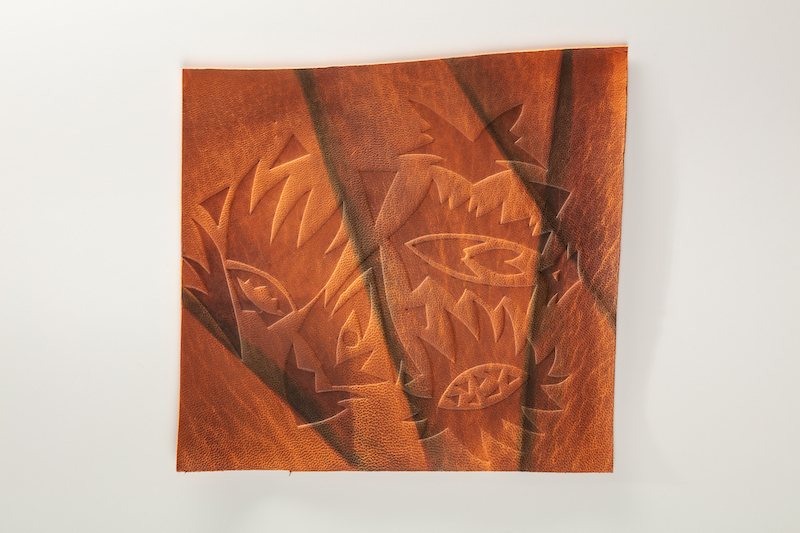

Foto: Meeli Küttim, Tobias Tikenberg, Jaana Päeva