
Academic Affairs OfficeAccessory DesignAnimationArchitecture and Urban DesignArt EducationCenter for Flat TechnologiesCeramicsContemporary ArtCultural Heritage and ConservationDepartmentsDesign and Technology FuturesDoctoral SchoolDrawingFacilities and WorkshopsFaculty of ArchitectureFaculty of Art and CultureFaculty of DesignFaculty of Fine ArtsFashion DesignFinancial DepartmentGalleryGlass ArtGraphic ArtGraphic DesignInstallation and SculptureInstitute of Art History and Visual CultureInternational OfficeIT OfficeJewellery and BlacksmithingLandscape ArchitectureLibraryLinnaehitus @enMaking SpaceNew MediaOffice of the RectorateOpen AcademyPaintingPerforming ArtsPhotographyProduct DesignRectorateResearch and Development OfficeScenographySupport UnitsTextile DesignUncategorizedUrban PlanningUrban Studies
Britta Benno: “Polar Wonder” in the Ice Age Center
03.06.2023 — 24.09.2023
Britta Benno: “Polar Wonder” in the Ice Age Center
On June 3, artist Britta Benno’s fictive space installation “Polar Wonder” will open in the Ice Age Center.
At Benno’s personal exhibition, it opens as an arctic oasis, with ice and landscape as the main characters, and the artist plays with forms and lines. The author’s drawing language expands into a multi-layered landscape abstraction in the exhibition.
The exhibition complements the so-called future floor of the Ice Age Center, which focuses on climate change and the environmental impact of human activity.
Britta Benno herself has described her exhibition as follows: “Drawings and graphics with a coolly glowing color palette wander in the plastic forms of ice, the openness of the image gives space for reflections and dreams. Mountains and landscapes are alive, mountains are the Inuit language. The North Pole belongs to dreams and creatures that flutter in all the layers of the earth. Ice in the form of our bouldery land, the weight of the mountains is still felt when walking on the ironed earth, the promises are still in the air.”
For the Ice Age Center, this exhibition has two meanings: through the artist, the beauty of the frozen landscapes unfolds, but at the same time, in terms of the environment, it is also important to point out that the melting of the ice fields has accelerated exponentially in recent years. The earth is changing and this is a big danger sign.
Although the exhibition called “Polar Dream” has traveled to Viljandi and Tallinn, the author prepared new works site-specifically for the Ice Age Center.
The artist thanks the animation director, Ragnar Neljandi, and the sculpture maker, Mai Eerik.
The exhibition is complemented by Juhan Vihterpal’s sound installation.
“Polar Wonder” will remain open until September 24.
Britta Benno (b. 1984) is a drawing and graphic artist. He is interested in different techniques and materials, and when they are juxtaposed and combined, new perspectives open up.
Benno graduated from the Estonian Academy of Arts with a master’s degree in graphic arts and furthered his education at the Vienna Academy of Arts. Benno is studying art and design in the doctoral program of the Estonian Academy of Arts, her artist research is called “Thinking in Layers, Worlding in Layers: Posthumanist Landscapes in the Extended Drawing and Printmaking” Artist website: www.brittabenno.com
Posted by Andres Lõo — Permalink
Britta Benno: “Polar Wonder” in the Ice Age Center
Saturday 03 June, 2023 — Sunday 24 September, 2023
On June 3, artist Britta Benno’s fictive space installation “Polar Wonder” will open in the Ice Age Center.
At Benno’s personal exhibition, it opens as an arctic oasis, with ice and landscape as the main characters, and the artist plays with forms and lines. The author’s drawing language expands into a multi-layered landscape abstraction in the exhibition.
The exhibition complements the so-called future floor of the Ice Age Center, which focuses on climate change and the environmental impact of human activity.
Britta Benno herself has described her exhibition as follows: “Drawings and graphics with a coolly glowing color palette wander in the plastic forms of ice, the openness of the image gives space for reflections and dreams. Mountains and landscapes are alive, mountains are the Inuit language. The North Pole belongs to dreams and creatures that flutter in all the layers of the earth. Ice in the form of our bouldery land, the weight of the mountains is still felt when walking on the ironed earth, the promises are still in the air.”
For the Ice Age Center, this exhibition has two meanings: through the artist, the beauty of the frozen landscapes unfolds, but at the same time, in terms of the environment, it is also important to point out that the melting of the ice fields has accelerated exponentially in recent years. The earth is changing and this is a big danger sign.
Although the exhibition called “Polar Dream” has traveled to Viljandi and Tallinn, the author prepared new works site-specifically for the Ice Age Center.
The artist thanks the animation director, Ragnar Neljandi, and the sculpture maker, Mai Eerik.
The exhibition is complemented by Juhan Vihterpal’s sound installation.
“Polar Wonder” will remain open until September 24.
Britta Benno (b. 1984) is a drawing and graphic artist. He is interested in different techniques and materials, and when they are juxtaposed and combined, new perspectives open up.
Benno graduated from the Estonian Academy of Arts with a master’s degree in graphic arts and furthered his education at the Vienna Academy of Arts. Benno is studying art and design in the doctoral program of the Estonian Academy of Arts, her artist research is called “Thinking in Layers, Worlding in Layers: Posthumanist Landscapes in the Extended Drawing and Printmaking” Artist website: www.brittabenno.com
Posted by Andres Lõo — Permalink
01.06.2023 — 17.06.2023
EKA Pop-Up Shop @ Tallinn Art Hall
TASE
EKA will once again open a POP-UP SHOP.
This time at Tallinn Art Hall where EKA Grad Show TASE ’23 is taking place.
Great chance to buy art and design made by EKA students!
Pop-up shop will be open on 1–17 june, Mon-Sun 12–18.
The original designs and works of art of the students of the Estonian Academy of Arts on sale in the EKA Pop-Up Shop.
Posted by Andres Lõo — Permalink
EKA Pop-Up Shop @ Tallinn Art Hall
Thursday 01 June, 2023 — Saturday 17 June, 2023
TASE
EKA will once again open a POP-UP SHOP.
This time at Tallinn Art Hall where EKA Grad Show TASE ’23 is taking place.
Great chance to buy art and design made by EKA students!
Pop-up shop will be open on 1–17 june, Mon-Sun 12–18.
The original designs and works of art of the students of the Estonian Academy of Arts on sale in the EKA Pop-Up Shop.
Posted by Andres Lõo — Permalink
05.06.2023 — 10.06.2023
Passing Tensators
Erasmus+
Dear everyone,
we invite you to “Passing Tensators”, an exhibition created by a group of Erasmus students from EKA during the spring semester, supervised by Johannes Luik.
The exhibition is the result of a continuous discourse and collection of ideas surrounding the specificity and underlying ideological contents of spaces. Due to the absence of a common mediality and functionality in
the practice among the individual students, the space itself generates the content and the formal aspects of the works.
Opening on Monday, 5. June at 18 h.
Open from 6. – 10. June 16 – 20 h.
Location: Manufaktuuri 5
We are looking forward to seeing you there!
Posted by Andres Lõo — Permalink
Passing Tensators
Monday 05 June, 2023 — Saturday 10 June, 2023
Erasmus+
Dear everyone,
we invite you to “Passing Tensators”, an exhibition created by a group of Erasmus students from EKA during the spring semester, supervised by Johannes Luik.
The exhibition is the result of a continuous discourse and collection of ideas surrounding the specificity and underlying ideological contents of spaces. Due to the absence of a common mediality and functionality in
the practice among the individual students, the space itself generates the content and the formal aspects of the works.
Opening on Monday, 5. June at 18 h.
Open from 6. – 10. June 16 – 20 h.
Location: Manufaktuuri 5
We are looking forward to seeing you there!
Posted by Andres Lõo — Permalink
12.06.2023
Peer review of Tõnis Jürgens’ exhibitions
Doctoral School
On 12 June at 15.00, the peer review of the exhibitions “Dreaming of Babylon” and “A Practice for Surrender” by Tõnis Jürgens, PhD student in Art and Design, will take place at the EKA, room A202.
Peer review event is in Estonian.
The event will be preceded by a screening of the video work “A Practice for Surrender” (2022, 12’49”) at 14.30, also in room A202. The film is in English.
The exhibitions are part of Tõnis Jürgens’ creative doctoral thesis. The thesis is about the digital measurement of sleep and the inevitable emergence of meaning in noise and patterns.
Supervisor of the thesis is Prof. Rolf Hughes (KU Leuven, Belgium).
The reviewers are Dr. Eva Näripea and Andrus Laansalu.
The exhibition “Dreaming of Babylon” was open at the Tartu Art Museum from 18.03.–14.05.2023, “The Exercise in Serenity” was open in the Vent Space project room from 20.–30.09.2022.
Posted by Irene Hütsi — Permalink
Peer review of Tõnis Jürgens’ exhibitions
Monday 12 June, 2023
Doctoral School
On 12 June at 15.00, the peer review of the exhibitions “Dreaming of Babylon” and “A Practice for Surrender” by Tõnis Jürgens, PhD student in Art and Design, will take place at the EKA, room A202.
Peer review event is in Estonian.
The event will be preceded by a screening of the video work “A Practice for Surrender” (2022, 12’49”) at 14.30, also in room A202. The film is in English.
The exhibitions are part of Tõnis Jürgens’ creative doctoral thesis. The thesis is about the digital measurement of sleep and the inevitable emergence of meaning in noise and patterns.
Supervisor of the thesis is Prof. Rolf Hughes (KU Leuven, Belgium).
The reviewers are Dr. Eva Näripea and Andrus Laansalu.
The exhibition “Dreaming of Babylon” was open at the Tartu Art Museum from 18.03.–14.05.2023, “The Exercise in Serenity” was open in the Vent Space project room from 20.–30.09.2022.
Posted by Irene Hütsi — Permalink
05.06.2023 — 06.06.2023
Defence presentations of Master’s theses in Contemporary Art and Animation curricula
Contemporary Art
Defence presentations of Master’s theses in Contemporary Art and Animation curricula
June 5–6, starting 10.00 at the TASE ‘23 exhibition at Tallinn Art Hall, Vabaduse väljak 8
5. juuni / June 5
10.00 – 10.45, VI floor
Heli Haav – master’s thesis: artistic component “Lilith” and written component ”Looking into the invisible: Attempts to find unspoken connections between the health of the Earth and the well-being of humankind”, supervisor Anu Vahtra (MA). Reviewer Elnara Taidre (PhD).
10.45 – 11.30, V floor
Jonathan Stavleu – master’s thesis entitled ”Museum of the 20th Century Archeology”, supervisor Anu Vahtra (MA). Reviewer Camille Laurelli (PhD).
11.30 – 12.15, IV floor
Samuel Lehikoinen – master’s thesis: artistic component “Unemployment Simulator 2018” and written component ”Everyday is Sunday”, supervisor John Grzinich (MA). Reviewer Taavi Varm (MA).
Lunch 12.15 – 13.15
13.15 – 14.00, III floor
M. Mojtaba H. Davijani – master’s thesis: artistic component “The Little Goldfish” and written component ”Shoot for Freedom”, supervisors John Grzinich (MA) and Kersti Uibo (MA). Reviewer David Ross (MA).
14.00 – 14.45, II floor, elevator
Stina Isabel Gavrilin – master’s thesis: artistic component “Break out. Give in.” and written component ”Seele Brennt”, supervisors John Grzinich (MA) and David Ross (MA). Reviewer Camille Laurelli (PhD).
15.45 – 16.30 ZOOM in EKA
Keawalee Warutkomain (Animation MA) – master’s thesis “Being-in-Between: A Journey to Contemplate the Notion of ‘Life/Death’ via an Improvisational Animation Approach”, supervisor Michael Croft (MA). Reviewer Mari-Liis Rebane (MA).
Assessment committee: Kristi Kongi, Sten Ojavee, Kristina Õllek, Agnė Jokšė, Rebecca Duclos.
/
6. juuni / June 6
10.00 – 10.45, Kunstihoone
Triin Türnpuu – magistritöö koondpealkirjaga „Kunst on sinu ümber. Pea meeles – võid katsuda, mitte vaadata!”, juhendajad Ingrid Allik (MA) ja Else Lagerspetz (MA). Retsensent Tamara Luuk (MA).
10.45 – 11.30, Kunstihoone
Marleen Suvi – magistritöö koondpealkirjaga „18:25”, juhendajad Merike Estna (MA) ja Eik Hermann (MA). Retsensent Kaarin Kivirähk (MA).
11.30 – 12.15, Kunstihoone
Lisann Lillevere – magistritöö loominguline osa „Sulav tõde” ja kirjalik osa „Ma ei tea, mis on reaalsus, aga ma tean, mis mulle meeldib”, juhendajad Marge Monko (MA) ja Helen Sirp (MA). Retsensent Elnara Taidre (PhD).
12.15 – 13.00, I korrus
Anselm Oja – magistritöö koondpealkirjaga „Tuunitud eneseotsingud pimedatel sisetänavatel”, juhendajad Reimo Võsa-Tangsoo (MA) ja Anu Vahtra (MA). Retsensent Elo Liiv (MA).
Paus 13.00 – 14.00
14.00 – 14.45, III korrus
Kristiina Aarna – magistritöö loominguline osa „518 päeva” ja kirjalik osa „Nähtamatu hääl ja hool naiskunstnike loomingus”, juhendaja Marge Monko (MA). Retsensent Brit Pavelson (MA).
14.45 – 15.30, III korrus
Heleliis Hõim – magistritöö koondpealkirjaga „Täitumatus (Unfulfilled)”, juhendaja Reimo Võsa-Tangsoo (MA). Retsensent Holger Loodus (MA).
15.30 – 16.15, VI korrus
Annika Hint – magistritöö loominguline osa “Recreate.betterlife.jpg” ja kirjalik osa “Trying to grasp a rainbow is the surest way to make it vanish”, juhendaja Taavi Talve (MA). Retsensent Hanno Soans (MA).
16.15 – 17.00, VI korrus
Liis-Marleen Verilaskja – magistritöö loominguline osa „Jumaliku surm: Apokalüptiline unenägu” ja kirjalik osa „Jõudmine unenäost usuni ja kunsti”, juhendajad Eve Kask (MA) ja Andrus Laansalu (MA). Retsensent Lilli-Krõõt Repnau (MA).
Hindamiskomisjon: Kristi Kongi, Sten Ojavee, Kristina Õllek, Sandra Kosorotova, Tõnis Saadoja.
Posted by Keidi Jaakson — Permalink
Defence presentations of Master’s theses in Contemporary Art and Animation curricula
Monday 05 June, 2023 — Tuesday 06 June, 2023
Contemporary Art
Defence presentations of Master’s theses in Contemporary Art and Animation curricula
June 5–6, starting 10.00 at the TASE ‘23 exhibition at Tallinn Art Hall, Vabaduse väljak 8
5. juuni / June 5
10.00 – 10.45, VI floor
Heli Haav – master’s thesis: artistic component “Lilith” and written component ”Looking into the invisible: Attempts to find unspoken connections between the health of the Earth and the well-being of humankind”, supervisor Anu Vahtra (MA). Reviewer Elnara Taidre (PhD).
10.45 – 11.30, V floor
Jonathan Stavleu – master’s thesis entitled ”Museum of the 20th Century Archeology”, supervisor Anu Vahtra (MA). Reviewer Camille Laurelli (PhD).
11.30 – 12.15, IV floor
Samuel Lehikoinen – master’s thesis: artistic component “Unemployment Simulator 2018” and written component ”Everyday is Sunday”, supervisor John Grzinich (MA). Reviewer Taavi Varm (MA).
Lunch 12.15 – 13.15
13.15 – 14.00, III floor
M. Mojtaba H. Davijani – master’s thesis: artistic component “The Little Goldfish” and written component ”Shoot for Freedom”, supervisors John Grzinich (MA) and Kersti Uibo (MA). Reviewer David Ross (MA).
14.00 – 14.45, II floor, elevator
Stina Isabel Gavrilin – master’s thesis: artistic component “Break out. Give in.” and written component ”Seele Brennt”, supervisors John Grzinich (MA) and David Ross (MA). Reviewer Camille Laurelli (PhD).
15.45 – 16.30 ZOOM in EKA
Keawalee Warutkomain (Animation MA) – master’s thesis “Being-in-Between: A Journey to Contemplate the Notion of ‘Life/Death’ via an Improvisational Animation Approach”, supervisor Michael Croft (MA). Reviewer Mari-Liis Rebane (MA).
Assessment committee: Kristi Kongi, Sten Ojavee, Kristina Õllek, Agnė Jokšė, Rebecca Duclos.
/
6. juuni / June 6
10.00 – 10.45, Kunstihoone
Triin Türnpuu – magistritöö koondpealkirjaga „Kunst on sinu ümber. Pea meeles – võid katsuda, mitte vaadata!”, juhendajad Ingrid Allik (MA) ja Else Lagerspetz (MA). Retsensent Tamara Luuk (MA).
10.45 – 11.30, Kunstihoone
Marleen Suvi – magistritöö koondpealkirjaga „18:25”, juhendajad Merike Estna (MA) ja Eik Hermann (MA). Retsensent Kaarin Kivirähk (MA).
11.30 – 12.15, Kunstihoone
Lisann Lillevere – magistritöö loominguline osa „Sulav tõde” ja kirjalik osa „Ma ei tea, mis on reaalsus, aga ma tean, mis mulle meeldib”, juhendajad Marge Monko (MA) ja Helen Sirp (MA). Retsensent Elnara Taidre (PhD).
12.15 – 13.00, I korrus
Anselm Oja – magistritöö koondpealkirjaga „Tuunitud eneseotsingud pimedatel sisetänavatel”, juhendajad Reimo Võsa-Tangsoo (MA) ja Anu Vahtra (MA). Retsensent Elo Liiv (MA).
Paus 13.00 – 14.00
14.00 – 14.45, III korrus
Kristiina Aarna – magistritöö loominguline osa „518 päeva” ja kirjalik osa „Nähtamatu hääl ja hool naiskunstnike loomingus”, juhendaja Marge Monko (MA). Retsensent Brit Pavelson (MA).
14.45 – 15.30, III korrus
Heleliis Hõim – magistritöö koondpealkirjaga „Täitumatus (Unfulfilled)”, juhendaja Reimo Võsa-Tangsoo (MA). Retsensent Holger Loodus (MA).
15.30 – 16.15, VI korrus
Annika Hint – magistritöö loominguline osa “Recreate.betterlife.jpg” ja kirjalik osa “Trying to grasp a rainbow is the surest way to make it vanish”, juhendaja Taavi Talve (MA). Retsensent Hanno Soans (MA).
16.15 – 17.00, VI korrus
Liis-Marleen Verilaskja – magistritöö loominguline osa „Jumaliku surm: Apokalüptiline unenägu” ja kirjalik osa „Jõudmine unenäost usuni ja kunsti”, juhendajad Eve Kask (MA) ja Andrus Laansalu (MA). Retsensent Lilli-Krõõt Repnau (MA).
Hindamiskomisjon: Kristi Kongi, Sten Ojavee, Kristina Õllek, Sandra Kosorotova, Tõnis Saadoja.
Posted by Keidi Jaakson — Permalink
21.06.2023
EKA Graduation Ceremonies 2023
This year’s Graduation Ceremonies will be held on June 21th in the EKA gallery and main hall (room A101, Põhja puiestee 7, Tallinn).
11am – graduates of Faculties of Design
3pm – graduates of Faculties of Architecture, Art Culture, Fine Arts and Doctoral School
NB! Dear graduate, please come to the EKA gallery 15 minutes earlier, so we can lead you to your place. Guests can sit in the hall or watch the ceremonies in the lobby on the screens or online on EKA TV.
Posted by Maarja Pabut — Permalink
EKA Graduation Ceremonies 2023
Wednesday 21 June, 2023
This year’s Graduation Ceremonies will be held on June 21th in the EKA gallery and main hall (room A101, Põhja puiestee 7, Tallinn).
11am – graduates of Faculties of Design
3pm – graduates of Faculties of Architecture, Art Culture, Fine Arts and Doctoral School
NB! Dear graduate, please come to the EKA gallery 15 minutes earlier, so we can lead you to your place. Guests can sit in the hall or watch the ceremonies in the lobby on the screens or online on EKA TV.
Posted by Maarja Pabut — Permalink
15.06.2023
Conference “Artistic Originality in the Age of AI”
Faculty of Fine Arts
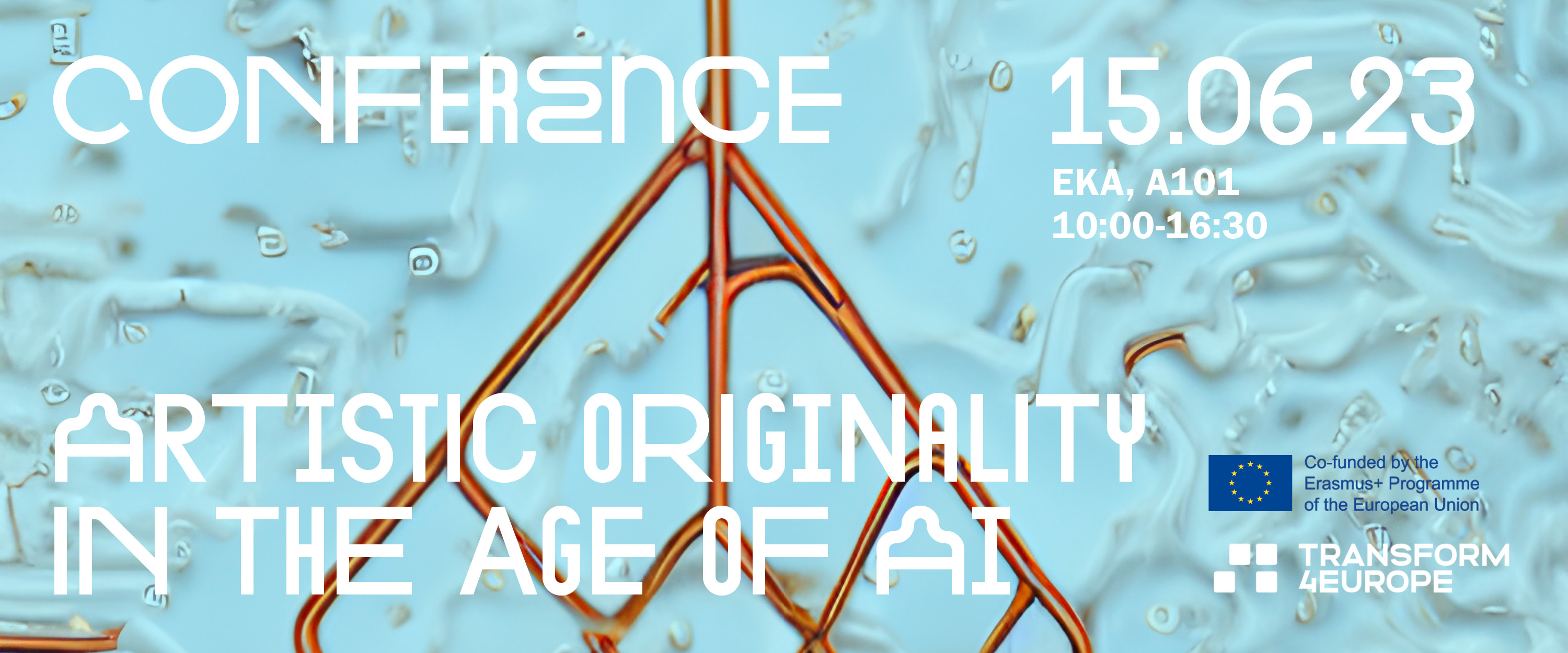
The conference “Artistic Originality in the Age of AI” will take place at the Estonian Academy of Arts on June 15, from 9.30am till 4.30pm.
The conference discusses historical and contemporary issues of originality and artistic innovation in the age of artificial intelligence. The main topic is to explore originality and novelty in art in a situation where creators are surrounded by a visually oversaturated environment; where creators have technology at their disposal that allows them to easily copy, modify and distribute their art; where professional (art-educated) creators have to compete with visually untrained creators; where digital technology participates not only as an aid and instrument of creation, but with the example of artificial intelligence programs tend to question the author’s visual ability.
Since digital technology has been involved in artistic creation and visual design for the past twenty or more years and has penetrated various creative fields, it is interesting to explore the influence of technology in art innovation in both traditional and new art forms: visual arts, design, architecture, ceramics, media art, art research.
Conference will be held in English and live streamed in EKA TV – tv.artun.ee. For registration please fill this FORM.
The event is part of the Transform4Europe Week program.
PROGRAMME
09.30 – 10.00 Welcome and Opening Remarks: Kirke Kangro, Dean of Fine Arts, Professor
10:00 – 10.45 Keynote presentation by Pau Waelder “Art in the Latent Space. Machine Learning as a Tool, a Co-Author and an Other”
10.45 – 11.00 Paco Ulman “Accidental Projections”
11.00 – 11.15 Zeynep Aksoez “Artificial Narratives”
11.15 – 11.30 Hasso Krull “Creative Ritual and Ritual Creativity”
11.30 – 11.45 Taavi Piibemann “Don’t be afraid, HAL.”
11:45 – 12:45 conversation, moderated by prof. Kirke Kangro
12:45 – 13:45 lunch
13.45 – 14.00 Andres Karjus “The human-technology continuum in text and image”
14.00 – 14.15 Oliver Laas “Norms in AI Systems”
14.15 – 14.30 Taavi Suisalu “AI in the mirror”
14.30 – 14.45 Varvara Guljajeva “AI-aided Ceramic Sculptures: Bridging Deep Learning with Materiality”
14.45 – 15.30 Keynote presentation by Lev Manovich “Artificial Aesthetics? Looking at AI Media Through the Lens of Art History”
15.30 – 16.30 – conversation, moderated by dr Raivo Kelomees
SPEAKERS
Pau Waelder “Art in the Latent Space. Machine Learning as a Tool, a Co-Author and an Other”
Senior Curator at Niio. Writer and researcher specialized in art and digital media. PhD in Information and Knowledge Society from the Universitat Oberta de Catalunya (UOC). Adjunct lecturer at the UOC, as well as in postgraduate courses. Editor and advisor at DAM Digital Art Museum. His work explores the different aspects of the interaction between art, technology and society, as well as the relationship between digital art and the art market. He is the author of the book on contemporary and digital art collecting You Can Be A Wealthy/ Cash-Strapped Art Collector In The Digital Age (Printer Fault Press, 2020).
Abstract
Since the dawn of algorithmic art, computers have entered the creative process as an active agent, engaging in a somewhat dialogical relationship with the artist. Machine learning programs have enabled computers to produce more sophisticated outputs, to the point of surpassing artists’ expectations. The precise instructions inscribed in a few lines of code have become prompts in natural language, with the final outcome emerging from an inscrutable latent space. As a field of uncharted possibilities, the latent space expands artists’ creativity and enables the perception of the program as an Other, an entity that is felt as alien while also deeply embedded in the artist’s self. This talk will address the latent space in connection with the notion of an Other and its implications in artistic creativity and originality.
Paco Ulman “Accidental Projections”
Since 2001 has worked as an architect in various offices (Ars Projekt, AB Kosmos, Arhitektuuriagentuur, Alianss Arhitektid). In 2013 he co-founded Mudel Architects studio. 2018-2020 worked at Tallinn Urban Planning Department and since 2021 works as an architect at the Tallinn Strategic Management Office.
Selection of projects in which he participated as co-author: Hotel Lydia in Tartu (2016), Hotel Lydia (2014), Pärnu Mud Baths hotel Hedon spa, Niine tn 11 office building extension project in Tallinn (2012).
In his artistic practice he is mainly focused on spatial issues and its representations using various different mediums. He has made exhibition and installation works, designed graphics, directed short films and animations, graphic novels, etc. Selection of solo exhibitions:„Heitmaa“ 2018a, „Tallinnas“ 2009a ja „Mememe“ 2014a. Since 2011 he has supervised various studios at Estonian Art Academy. From 2021 he is a PhD student in Architecture and Art at EKA Architecture and Urban Planning department.
Zeynep Aksöz “Artificial Narratives”
Zeynep Aksöz is an architect and a creative coder. She is one of two partners of Vienna-based design and research collective Open Fields. Currently she is a Research Associate and a lecturer at University of AppliedArtsVienna, an Assistant Professor at TU Vienna in Department for Structural Design, Faculty in IAACBarcelona.Through her ongoing research, teaching, and practice Zeynep explores generative design and the implementation of AI based processes into design, architecture, and urbanism. Her focus lies in developing emergent design approaches through the collaboration of human and artificial intelligence.
Zeynep is the recipient ofResearch Prize for Architecture from the National Chamber of Architects, Austria and a former Marie Curie fellow. Together with Mark Balzar, BernhardSommer,and Galo Moncayo she is the recipient of FWF PEEK funding for their Project Vibrant Fields.In collaboration with Nicolaj Kirisits she received INTRA funding for the project titled Morphology of Sound. Her creative and scientific work has been published in books such as Fabricate, Design Transactions, in conference proceedings including Design Modeling Symposium, Acadia as well as in the architecture magazineManege. Zeynep has exhibited her work at the Vienna Design Week, Bratislava Design Week, inKADKCopenhagen, Salona di Mobile in Milan, London Design Festival, Daniels School of Architecture in Toronto, andArchitecture Biennale die Venezia. Zeynep received her Doctoral degree from the University of Applied Arts Vienna at the Institute of Architecture under the supervision of Klaus Bollinger. She was a Marie Curie Fellow and an early-stage researcher in the international training network Innochain. She holds a MArch degree from the Architectural Association of London’s Emergent Technologies and Design Program and an MSc degree from TU Wien.
Hasso Krull “Creative Ritual and Ritual Creativity”
Hasso Krull (b. 1964) is an Estonian poet who has published sixteen books of poetry and nine collections of essays that include literary criticism as well as writings concerning art, cinema and society. During 1990-2017 he was teaching cultural theory at the Estonian Institute of Humanities (special courses on creation myths, oral tradition, continental philosophy and psychoanalysis). In 2001 Krull founded a poetry translation review Ninniku with Kalju Kruusa (www.eki.ee/ninniku/), in 2003 there followed a book series Ninniku Raamatukogu. Lately Krull has been concerned with ecological issues and the ongoing devastation of the Estonian forests.
Taavi Piibemann “Don’t be afraid, HAL.”
Taavi Piibemann started his stint as a carpenter, taught art at the Estonian Academy of Arts and Pallas in Tartu. Choose to do that after three years of copywriting, what back then seemed like a logical application of his study of photography at Tartu Art College and English language and literature at Tartu University. Beyond that there’s idyllic rural childhood in Viinistu, a small seaside village at the Gulf of Finland.
Andres Karjus “The human-technology continuum in text and image”
Andres Karjus is a research fellow in cultural data analytics at Tallinn University, and also operates in the private sector as an instructor on digital skills and AI. He has a background in the humanities (PhD in linguistics) and computer science (MSc in AI), and regularly engages with both in his teaching and research practice.
Oliver Laas “Norms in AI Systems”
Oliver Laas is a philosopher whose work focuses on philosophy of technology, philosophy of language, logic and metaphysics. He has written about artificial intelligence, arguments from analogy, definitions, truthlikeness in history, video games, and virtual reality.
Taavi Suisalu “AI in the mirror”
Taavi Suisalu is an artist who blends traditional and contemporary sensibilities and activates peripheral spaces for imaginative encounters. He has recorded volcanoes and malfunctioning satellites, composed for lawnmowers, intertwined living and digital ecosystems, explored datafictions and how developments in technologies shape our environments and influence behavior, perception and thinking of social beings. Suisalu has studied sociology and computer science in University of Tartu, contemporary art practices in Geneva University of Art and Design and earned his MA degree from Estonian Academy of Arts. He has participated in residency programmes in Nida Art Colony, WRO Art Center and International Studio & Curatorial Program (ISCP) amongst others.
Varvara Guljajeva “AI-aided Ceramic Sculptures: Bridging Deep Learning with Materiality”
Dr Varvara Guljajeva is an Assistant Professor in Computational Media and Arts at the Hong Kong University of Science and Technology (Guangzhou). Previously, she held positions at the Estonian Academy of Arts and Elisava Design School in Barcelona. Her PhD thesis “From Interaction to Post-Participation: The Disappearing Role of the Active Participant” was selected as the highest-ranking abstracts by Leonardo Labs in 2020. As an artist, she works together with Mar Canet forming an artist duo Varvara & Mar. Often the duo’s work is inspired by the information age. Their works were shown at MAD, Barbican, Ars Electronica, ZKM, etc. www.var-mar.info
Lev Manovich “Artificial Aesthetics? Looking at AI Media Through the Lens of Art History”
Lev Manovich is a visual artist, writer, and one of the world’s most influential digital culture theorists. He was included in the lists of “25 People Shaping the Future of Design” (Complex, 2013) and “50 Most Interesting People Building the Future” (Verge, 2014). Manovich is a Presidential Professor at The Graduate Center, City University of New York, and a Director of the Cultural Analytics Lab. He has published 180 articles and 15 books that include AI Aesthetics, Cultural Analytics, Instagram and Contemporary Image, and The Language of New Media described as “the most suggestive and broad-ranging media history since Marshall McLuhan.” His digital art projects were shown in eight personal and 120 international groups exhibitions in Centre Pompidou, ICA London, ZKM, KIASMA, and other leading venues.
Posted by Kati Saarits — Permalink
Conference “Artistic Originality in the Age of AI”
Thursday 15 June, 2023
Faculty of Fine Arts
The conference “Artistic Originality in the Age of AI” will take place at the Estonian Academy of Arts on June 15, from 9.30am till 4.30pm.
The conference discusses historical and contemporary issues of originality and artistic innovation in the age of artificial intelligence. The main topic is to explore originality and novelty in art in a situation where creators are surrounded by a visually oversaturated environment; where creators have technology at their disposal that allows them to easily copy, modify and distribute their art; where professional (art-educated) creators have to compete with visually untrained creators; where digital technology participates not only as an aid and instrument of creation, but with the example of artificial intelligence programs tend to question the author’s visual ability.
Since digital technology has been involved in artistic creation and visual design for the past twenty or more years and has penetrated various creative fields, it is interesting to explore the influence of technology in art innovation in both traditional and new art forms: visual arts, design, architecture, ceramics, media art, art research.
Conference will be held in English and live streamed in EKA TV – tv.artun.ee. For registration please fill this FORM.
The event is part of the Transform4Europe Week program.
PROGRAMME
09.30 – 10.00 Welcome and Opening Remarks: Kirke Kangro, Dean of Fine Arts, Professor
10:00 – 10.45 Keynote presentation by Pau Waelder “Art in the Latent Space. Machine Learning as a Tool, a Co-Author and an Other”
10.45 – 11.00 Paco Ulman “Accidental Projections”
11.00 – 11.15 Zeynep Aksoez “Artificial Narratives”
11.15 – 11.30 Hasso Krull “Creative Ritual and Ritual Creativity”
11.30 – 11.45 Taavi Piibemann “Don’t be afraid, HAL.”
11:45 – 12:45 conversation, moderated by prof. Kirke Kangro
12:45 – 13:45 lunch
13.45 – 14.00 Andres Karjus “The human-technology continuum in text and image”
14.00 – 14.15 Oliver Laas “Norms in AI Systems”
14.15 – 14.30 Taavi Suisalu “AI in the mirror”
14.30 – 14.45 Varvara Guljajeva “AI-aided Ceramic Sculptures: Bridging Deep Learning with Materiality”
14.45 – 15.30 Keynote presentation by Lev Manovich “Artificial Aesthetics? Looking at AI Media Through the Lens of Art History”
15.30 – 16.30 – conversation, moderated by dr Raivo Kelomees
SPEAKERS
Pau Waelder “Art in the Latent Space. Machine Learning as a Tool, a Co-Author and an Other”
Senior Curator at Niio. Writer and researcher specialized in art and digital media. PhD in Information and Knowledge Society from the Universitat Oberta de Catalunya (UOC). Adjunct lecturer at the UOC, as well as in postgraduate courses. Editor and advisor at DAM Digital Art Museum. His work explores the different aspects of the interaction between art, technology and society, as well as the relationship between digital art and the art market. He is the author of the book on contemporary and digital art collecting You Can Be A Wealthy/ Cash-Strapped Art Collector In The Digital Age (Printer Fault Press, 2020).
Abstract
Since the dawn of algorithmic art, computers have entered the creative process as an active agent, engaging in a somewhat dialogical relationship with the artist. Machine learning programs have enabled computers to produce more sophisticated outputs, to the point of surpassing artists’ expectations. The precise instructions inscribed in a few lines of code have become prompts in natural language, with the final outcome emerging from an inscrutable latent space. As a field of uncharted possibilities, the latent space expands artists’ creativity and enables the perception of the program as an Other, an entity that is felt as alien while also deeply embedded in the artist’s self. This talk will address the latent space in connection with the notion of an Other and its implications in artistic creativity and originality.
Paco Ulman “Accidental Projections”
Since 2001 has worked as an architect in various offices (Ars Projekt, AB Kosmos, Arhitektuuriagentuur, Alianss Arhitektid). In 2013 he co-founded Mudel Architects studio. 2018-2020 worked at Tallinn Urban Planning Department and since 2021 works as an architect at the Tallinn Strategic Management Office.
Selection of projects in which he participated as co-author: Hotel Lydia in Tartu (2016), Hotel Lydia (2014), Pärnu Mud Baths hotel Hedon spa, Niine tn 11 office building extension project in Tallinn (2012).
In his artistic practice he is mainly focused on spatial issues and its representations using various different mediums. He has made exhibition and installation works, designed graphics, directed short films and animations, graphic novels, etc. Selection of solo exhibitions:„Heitmaa“ 2018a, „Tallinnas“ 2009a ja „Mememe“ 2014a. Since 2011 he has supervised various studios at Estonian Art Academy. From 2021 he is a PhD student in Architecture and Art at EKA Architecture and Urban Planning department.
Zeynep Aksöz “Artificial Narratives”
Zeynep Aksöz is an architect and a creative coder. She is one of two partners of Vienna-based design and research collective Open Fields. Currently she is a Research Associate and a lecturer at University of AppliedArtsVienna, an Assistant Professor at TU Vienna in Department for Structural Design, Faculty in IAACBarcelona.Through her ongoing research, teaching, and practice Zeynep explores generative design and the implementation of AI based processes into design, architecture, and urbanism. Her focus lies in developing emergent design approaches through the collaboration of human and artificial intelligence.
Zeynep is the recipient ofResearch Prize for Architecture from the National Chamber of Architects, Austria and a former Marie Curie fellow. Together with Mark Balzar, BernhardSommer,and Galo Moncayo she is the recipient of FWF PEEK funding for their Project Vibrant Fields.In collaboration with Nicolaj Kirisits she received INTRA funding for the project titled Morphology of Sound. Her creative and scientific work has been published in books such as Fabricate, Design Transactions, in conference proceedings including Design Modeling Symposium, Acadia as well as in the architecture magazineManege. Zeynep has exhibited her work at the Vienna Design Week, Bratislava Design Week, inKADKCopenhagen, Salona di Mobile in Milan, London Design Festival, Daniels School of Architecture in Toronto, andArchitecture Biennale die Venezia. Zeynep received her Doctoral degree from the University of Applied Arts Vienna at the Institute of Architecture under the supervision of Klaus Bollinger. She was a Marie Curie Fellow and an early-stage researcher in the international training network Innochain. She holds a MArch degree from the Architectural Association of London’s Emergent Technologies and Design Program and an MSc degree from TU Wien.
Hasso Krull “Creative Ritual and Ritual Creativity”
Hasso Krull (b. 1964) is an Estonian poet who has published sixteen books of poetry and nine collections of essays that include literary criticism as well as writings concerning art, cinema and society. During 1990-2017 he was teaching cultural theory at the Estonian Institute of Humanities (special courses on creation myths, oral tradition, continental philosophy and psychoanalysis). In 2001 Krull founded a poetry translation review Ninniku with Kalju Kruusa (www.eki.ee/ninniku/), in 2003 there followed a book series Ninniku Raamatukogu. Lately Krull has been concerned with ecological issues and the ongoing devastation of the Estonian forests.
Taavi Piibemann “Don’t be afraid, HAL.”
Taavi Piibemann started his stint as a carpenter, taught art at the Estonian Academy of Arts and Pallas in Tartu. Choose to do that after three years of copywriting, what back then seemed like a logical application of his study of photography at Tartu Art College and English language and literature at Tartu University. Beyond that there’s idyllic rural childhood in Viinistu, a small seaside village at the Gulf of Finland.
Andres Karjus “The human-technology continuum in text and image”
Andres Karjus is a research fellow in cultural data analytics at Tallinn University, and also operates in the private sector as an instructor on digital skills and AI. He has a background in the humanities (PhD in linguistics) and computer science (MSc in AI), and regularly engages with both in his teaching and research practice.
Oliver Laas “Norms in AI Systems”
Oliver Laas is a philosopher whose work focuses on philosophy of technology, philosophy of language, logic and metaphysics. He has written about artificial intelligence, arguments from analogy, definitions, truthlikeness in history, video games, and virtual reality.
Taavi Suisalu “AI in the mirror”
Taavi Suisalu is an artist who blends traditional and contemporary sensibilities and activates peripheral spaces for imaginative encounters. He has recorded volcanoes and malfunctioning satellites, composed for lawnmowers, intertwined living and digital ecosystems, explored datafictions and how developments in technologies shape our environments and influence behavior, perception and thinking of social beings. Suisalu has studied sociology and computer science in University of Tartu, contemporary art practices in Geneva University of Art and Design and earned his MA degree from Estonian Academy of Arts. He has participated in residency programmes in Nida Art Colony, WRO Art Center and International Studio & Curatorial Program (ISCP) amongst others.
Varvara Guljajeva “AI-aided Ceramic Sculptures: Bridging Deep Learning with Materiality”
Dr Varvara Guljajeva is an Assistant Professor in Computational Media and Arts at the Hong Kong University of Science and Technology (Guangzhou). Previously, she held positions at the Estonian Academy of Arts and Elisava Design School in Barcelona. Her PhD thesis “From Interaction to Post-Participation: The Disappearing Role of the Active Participant” was selected as the highest-ranking abstracts by Leonardo Labs in 2020. As an artist, she works together with Mar Canet forming an artist duo Varvara & Mar. Often the duo’s work is inspired by the information age. Their works were shown at MAD, Barbican, Ars Electronica, ZKM, etc. www.var-mar.info
Lev Manovich “Artificial Aesthetics? Looking at AI Media Through the Lens of Art History”
Lev Manovich is a visual artist, writer, and one of the world’s most influential digital culture theorists. He was included in the lists of “25 People Shaping the Future of Design” (Complex, 2013) and “50 Most Interesting People Building the Future” (Verge, 2014). Manovich is a Presidential Professor at The Graduate Center, City University of New York, and a Director of the Cultural Analytics Lab. He has published 180 articles and 15 books that include AI Aesthetics, Cultural Analytics, Instagram and Contemporary Image, and The Language of New Media described as “the most suggestive and broad-ranging media history since Marshall McLuhan.” His digital art projects were shown in eight personal and 120 international groups exhibitions in Centre Pompidou, ICA London, ZKM, KIASMA, and other leading venues.
Posted by Kati Saarits — Permalink
02.06.2023 — 01.07.2023
Alexei Gordin in Vaal Gallery
Painting
EKA painting alumnus Alexei Gordin opens exhibition “Dreams Come True in this Gallery” in Vaal Gallery.
“Recently, I was scanning the traces of my online existence and dug up my very first posted artwork, a 2006 pencil drawing called ‘A Place Under the Sun’. It has been 16 years since it happened, 10 of which I’ve been part of the professional art world, but the question about the right place under the Sun is still relevant. So where is the artist’s place?
To answer this question, one can speculate on various topics, but one thing is clear to me – the artist’s place is in the gallery. This can be taken as a devastating fact, because the principles and aims of art are beyond the four walls. In reality, however, it is between the walls of the gallery where professional art begins and ends, because only there can it be professionally rated. To quote O. Doherty: ‘From this moment on, there is a seepage of energy from art to its surroundings. With time the ratio between the literalization of art and mythification of the gallery inversely increases’.”
The exhibition “Dreams Come True in this Gallery” is a parody of a situation where someone is trying to find a way out of the art that is currently drowned in the gallery space. The title comes from the aesthetics of advertising industry, where market players sell promises to their customers that their dreams will come true, but the more the consumer invests energy in fulfilling their dreams, the more distant those dreams remain. Gordin’s approach to the question of the artist’s place under the Sun is autobiographical rather than conceptual. In philosophical terms, the artist’s place becomes ephemeral, dissolving into temporary concepts, residencies and biennials.
Alexei Gordin (b 1989) is mainly known as a painter, however, he also works with photography, video and performance. Using black humour, Gordin draws attention to the absurdity of the (art) world and alienation, highlighting issues like inequality and the difficulties of marginalised groups. Gordin’s work is influenced by caricatures and it combines texts and pictures, referring to comics and meme culture.
The exhibition will remain open until 1st of July, Tue–Fri 12–6 pm, Sat 12–4 pm.
Posted by Andres Lõo — Permalink
Alexei Gordin in Vaal Gallery
Friday 02 June, 2023 — Saturday 01 July, 2023
Painting
EKA painting alumnus Alexei Gordin opens exhibition “Dreams Come True in this Gallery” in Vaal Gallery.
“Recently, I was scanning the traces of my online existence and dug up my very first posted artwork, a 2006 pencil drawing called ‘A Place Under the Sun’. It has been 16 years since it happened, 10 of which I’ve been part of the professional art world, but the question about the right place under the Sun is still relevant. So where is the artist’s place?
To answer this question, one can speculate on various topics, but one thing is clear to me – the artist’s place is in the gallery. This can be taken as a devastating fact, because the principles and aims of art are beyond the four walls. In reality, however, it is between the walls of the gallery where professional art begins and ends, because only there can it be professionally rated. To quote O. Doherty: ‘From this moment on, there is a seepage of energy from art to its surroundings. With time the ratio between the literalization of art and mythification of the gallery inversely increases’.”
The exhibition “Dreams Come True in this Gallery” is a parody of a situation where someone is trying to find a way out of the art that is currently drowned in the gallery space. The title comes from the aesthetics of advertising industry, where market players sell promises to their customers that their dreams will come true, but the more the consumer invests energy in fulfilling their dreams, the more distant those dreams remain. Gordin’s approach to the question of the artist’s place under the Sun is autobiographical rather than conceptual. In philosophical terms, the artist’s place becomes ephemeral, dissolving into temporary concepts, residencies and biennials.
Alexei Gordin (b 1989) is mainly known as a painter, however, he also works with photography, video and performance. Using black humour, Gordin draws attention to the absurdity of the (art) world and alienation, highlighting issues like inequality and the difficulties of marginalised groups. Gordin’s work is influenced by caricatures and it combines texts and pictures, referring to comics and meme culture.
The exhibition will remain open until 1st of July, Tue–Fri 12–6 pm, Sat 12–4 pm.
Posted by Andres Lõo — Permalink
01.06.2023 — 17.06.2023
SLENDERhood: Neighbourhood based renovation
Architecture and Urban Design
Exhibition of student works of
the III course of the EKA Faculty of Architecture.
The design studio focused on volumetric renovation and neighbourhood-based reconstruction on the example of the Mustamäe settlement. We looked at the renovation of six series 1-464 standard apartment buildings, offering alternatives for parking, accessibility, energy efficiency and other public benefits. As a result of the semester, 7 different approaches were proposed to improve the quality of life and strengthen the community in Mustamäe.
Õppejõud / supervisors: Sille Pihlak, Siim Tuksam (arhitektuur), Adam Orlinski (inseneeria ja energia disain)
Konsultandid / consultants: Karin Bachmann (maastikuarhitektuur), Teet Tark (vesi ja ventilatsioon)
Eksperdid / experts: Nadežda Sassina (kogukonna kaasamine)
Tudengid / students: Heinrike Aue, Mariia Babur, Julia Freudenberg, Sander Haugas, Janely Järv, Robert Kiisler, Augustas Lapinskas, Lukas Laubre, Paula Līva Lorence, Laura
Susanna Lätte, Katriin Maitsalu, Jarþrúður Másdóttir, Mariia Paslova, Yelyzaveta Peresada, Daria Polonska, Ella Mari Roosi, Erik Sammel, Helerin Talpsepp, Mariia Ufimtseva,
Triin Vaino, Markus Vernik, Anneli Virts.
Kuraatorid ja näituse kujundus: Ella Mari Roosi, Julia Freudenberg
Graafiline disain: Janely Järv, Laura Susanna Lätte
Projektijuht: Anna Tommingas
Posted by Anna Tommingas — Permalink
SLENDERhood: Neighbourhood based renovation
Thursday 01 June, 2023 — Saturday 17 June, 2023
Architecture and Urban Design
Exhibition of student works of
the III course of the EKA Faculty of Architecture.
The design studio focused on volumetric renovation and neighbourhood-based reconstruction on the example of the Mustamäe settlement. We looked at the renovation of six series 1-464 standard apartment buildings, offering alternatives for parking, accessibility, energy efficiency and other public benefits. As a result of the semester, 7 different approaches were proposed to improve the quality of life and strengthen the community in Mustamäe.
Õppejõud / supervisors: Sille Pihlak, Siim Tuksam (arhitektuur), Adam Orlinski (inseneeria ja energia disain)
Konsultandid / consultants: Karin Bachmann (maastikuarhitektuur), Teet Tark (vesi ja ventilatsioon)
Eksperdid / experts: Nadežda Sassina (kogukonna kaasamine)
Tudengid / students: Heinrike Aue, Mariia Babur, Julia Freudenberg, Sander Haugas, Janely Järv, Robert Kiisler, Augustas Lapinskas, Lukas Laubre, Paula Līva Lorence, Laura
Susanna Lätte, Katriin Maitsalu, Jarþrúður Másdóttir, Mariia Paslova, Yelyzaveta Peresada, Daria Polonska, Ella Mari Roosi, Erik Sammel, Helerin Talpsepp, Mariia Ufimtseva,
Triin Vaino, Markus Vernik, Anneli Virts.
Kuraatorid ja näituse kujundus: Ella Mari Roosi, Julia Freudenberg
Graafiline disain: Janely Järv, Laura Susanna Lätte
Projektijuht: Anna Tommingas
Posted by Anna Tommingas — Permalink
08.06.2023
Portfolio Café 2023
Faculty of Fine Arts
June 8 at EKA Library
Portfolio Café is an event that takes place each spring semester as a satellite event to EKA graduation show TASE. It is structured around one-on-one meetings between invited fine arts field professionals and EKA BA and MA level students. Each meeting takes place about 30 minutes. During Portfolio Café sessions students introduce themselves and their work and experts share their observations, provide recommendations, ask questions etc.
All Portfolio Café meetings are in English.
Registration: Portfolio Café invites all fine art students from the BA and MA level to participate. The spots are limited and participants will be chosen according to the provided portfolios.
To apply, please fill out this registration form lates on June 5.
EXPERTS
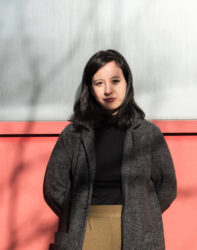
Paola Jalili (she / her) is an artist-publisher and cultural worker currently based in Helsinki. In 2021, she started Ei Mainoksia, Kiitos!, an independent art publishing initiative that aims to prioritize care and highlight the time and labor behind the act of publishing. She is part of Feminist Culture House, a curatorial and editorial platform that works with and for underrepresented artists, and produces tools for more equitable collaborations within the arts. In her visual arts practice, Paola reflects on the intersections between labor, gender, and the contemporary workplace. You can read more about her work at paolajalili.xyz
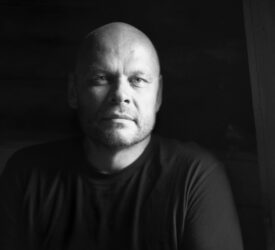
Kurt Vanbelleghem (Belgium, 1968) is a curator, critic and publisher specialized in the field of contemporary art and design. He received a MA in Psychological Sciences and an MA in Art History at the University of Ghent (B) and a Master in Visual Arts Administration at the Royal College of Art, London (UK).
Through his organization PresentFuture, he focuses on the artistic & professional development of contemporary artistic practices. He is specialized in the development of new curatorial, strategic and digital trajectories. In doing, he provides perspectives to navigate the opportunities and challenges ahead. An ongoing goal is to create synergies between different artistic disciplines as well as between artistic and technological & scientific innovations. He is alumni coach at St Lucas Antwerp and artistic advisor at several art organizations and higher art education institutions. He has been a contributing editor to a number of art & design magazines and has published several monographs and artist’s books.

Agnė Jokšė (b. 1993, Vilnius) is an artist and writer working between Vilnius and Copenhagen. In films, written pieces and performances Jokšė investigates questions concerning queerness, non-normative language, parallel histories and entangled relations.
Recently, Jokšė’s works has been shown at E-flux Screening Room (New York), Kogo Gallery (Tartu), Cell Project Space (London), Editorial (Vilnius), Kunsthal Charlottenborg, Copenhagen (2022), Artists’ Film International, Whitechapel Gallery, London (2021); Baltic Triennial 14 (2021). The artist’s work Dear Friend was granted the JCDecaux Award in 2019.
Posted by Kati Saarits — Permalink
Portfolio Café 2023
Thursday 08 June, 2023
Faculty of Fine Arts
June 8 at EKA Library
Portfolio Café is an event that takes place each spring semester as a satellite event to EKA graduation show TASE. It is structured around one-on-one meetings between invited fine arts field professionals and EKA BA and MA level students. Each meeting takes place about 30 minutes. During Portfolio Café sessions students introduce themselves and their work and experts share their observations, provide recommendations, ask questions etc.
All Portfolio Café meetings are in English.
Registration: Portfolio Café invites all fine art students from the BA and MA level to participate. The spots are limited and participants will be chosen according to the provided portfolios.
To apply, please fill out this registration form lates on June 5.
EXPERTS
Paola Jalili (she / her) is an artist-publisher and cultural worker currently based in Helsinki. In 2021, she started Ei Mainoksia, Kiitos!, an independent art publishing initiative that aims to prioritize care and highlight the time and labor behind the act of publishing. She is part of Feminist Culture House, a curatorial and editorial platform that works with and for underrepresented artists, and produces tools for more equitable collaborations within the arts. In her visual arts practice, Paola reflects on the intersections between labor, gender, and the contemporary workplace. You can read more about her work at paolajalili.xyz
Kurt Vanbelleghem (Belgium, 1968) is a curator, critic and publisher specialized in the field of contemporary art and design. He received a MA in Psychological Sciences and an MA in Art History at the University of Ghent (B) and a Master in Visual Arts Administration at the Royal College of Art, London (UK).
Through his organization PresentFuture, he focuses on the artistic & professional development of contemporary artistic practices. He is specialized in the development of new curatorial, strategic and digital trajectories. In doing, he provides perspectives to navigate the opportunities and challenges ahead. An ongoing goal is to create synergies between different artistic disciplines as well as between artistic and technological & scientific innovations. He is alumni coach at St Lucas Antwerp and artistic advisor at several art organizations and higher art education institutions. He has been a contributing editor to a number of art & design magazines and has published several monographs and artist’s books.
Agnė Jokšė (b. 1993, Vilnius) is an artist and writer working between Vilnius and Copenhagen. In films, written pieces and performances Jokšė investigates questions concerning queerness, non-normative language, parallel histories and entangled relations.
Recently, Jokšė’s works has been shown at E-flux Screening Room (New York), Kogo Gallery (Tartu), Cell Project Space (London), Editorial (Vilnius), Kunsthal Charlottenborg, Copenhagen (2022), Artists’ Film International, Whitechapel Gallery, London (2021); Baltic Triennial 14 (2021). The artist’s work Dear Friend was granted the JCDecaux Award in 2019.
Posted by Kati Saarits — Permalink