
Open Lectures
09.03.2020
Open lecture on electroacoustic music: Yiorgis Sakellariou
Composing the Sublime: Rituals in Electroacoustic Music
Can electroacoustic music concerts become places of ritual?
Open lecture on Monday, 9.03. at 16:00, room A302
In this talk, Yiorgis Sakellariou (GR) will explore this question that marked the beginning of an analytical and practical research of the social existence of electroacoustic music and the sublime experience of acousmatic listening.
The research expands the framework of sonic arts and suggests methods for further theoretical interrogation and artistic practice. Having taken a qualitative methodological approach, the research drew inspiration from ethnomusicological and anthropological contexts and used digital sound technology to embody the evocative and transcendental atmosphere of religious rituals in electroacoustic music concerts.
The artistic outcomes (published compositions and public performances) focus on the communal experience of listening and the communication between composer, audiences, performance spaces and the rest of the physical and supernatural world.
Yiorgis Sakellariou is a composer of experimental and electroacoustic music. Since 2003, he has been active internationally being responsible for solo and collaboration albums, having composed music for short films and theatrical performances, leading workshops and ceaselessly performing his music around the globe.
His practice focuses on the communal experience of listening and the communication between composer, audiences, performance spaces and the rest of the physical and supernatural world. He only performs in absolute darkness, fostering an all-inclusive and profoundly submerging sonic experience.
He completed his PhD at Coventry University (April 2018). His research drew inspiration from ethnomusicological and anthropological contexts and explored the sonic symbolism and socio-aesthetic settings in ecstatic religious rituals in relation to field recording, electroacoustic composition and acousmatic performance.
Yiorgis Sakellariou is a member of the Athenian Contemporary Music Research Centre, the Hellenic Electroacoustic Music Composers Association and the Lithuanian Composers Union. Since 2004 he has curated the label Echomusic. He is currently a lecturer at VDU and an assistant lecturer at LMTA.
https://mechaorga.wordpress.com/
Open lecture on electroacoustic music: Yiorgis Sakellariou
Monday 09 March, 2020
Composing the Sublime: Rituals in Electroacoustic Music
Can electroacoustic music concerts become places of ritual?
Open lecture on Monday, 9.03. at 16:00, room A302
In this talk, Yiorgis Sakellariou (GR) will explore this question that marked the beginning of an analytical and practical research of the social existence of electroacoustic music and the sublime experience of acousmatic listening.
The research expands the framework of sonic arts and suggests methods for further theoretical interrogation and artistic practice. Having taken a qualitative methodological approach, the research drew inspiration from ethnomusicological and anthropological contexts and used digital sound technology to embody the evocative and transcendental atmosphere of religious rituals in electroacoustic music concerts.
The artistic outcomes (published compositions and public performances) focus on the communal experience of listening and the communication between composer, audiences, performance spaces and the rest of the physical and supernatural world.
Yiorgis Sakellariou is a composer of experimental and electroacoustic music. Since 2003, he has been active internationally being responsible for solo and collaboration albums, having composed music for short films and theatrical performances, leading workshops and ceaselessly performing his music around the globe.
His practice focuses on the communal experience of listening and the communication between composer, audiences, performance spaces and the rest of the physical and supernatural world. He only performs in absolute darkness, fostering an all-inclusive and profoundly submerging sonic experience.
He completed his PhD at Coventry University (April 2018). His research drew inspiration from ethnomusicological and anthropological contexts and explored the sonic symbolism and socio-aesthetic settings in ecstatic religious rituals in relation to field recording, electroacoustic composition and acousmatic performance.
Yiorgis Sakellariou is a member of the Athenian Contemporary Music Research Centre, the Hellenic Electroacoustic Music Composers Association and the Lithuanian Composers Union. Since 2004 he has curated the label Echomusic. He is currently a lecturer at VDU and an assistant lecturer at LMTA.
https://mechaorga.wordpress.com/
12.03.2020
Canceled: Open Lecture by architect Wolf D. Prix
NB! The lecture is CANCELED!
HIMMELB(L)AU 68 Revisited: We will not allow Art to be exiled from Architecture. Open Lecture by Wolf D. Prix
Arriving to Tallinn on 12 March is the co-founder, Design Principal and CEO of Vienna-based international architecture practice COOP HIMMELB(L)AU Wolf D. Prix, according to whom COOP HIMMELB(L)AU does not so much as fight gravity with their buildings which often seem to float or sway, but rather tries to ignore gravity in the first place. Prix’s lecture is titled “HIMMELB(L)AU 68 Revisited. We will not allow Art to be exiled from Architecture” and is part of the Estonian Academy of Arts architecture open lecture series. All lectures are free and open for all.
Wolf D. Prix studied architecture at the Vienna University of Technology, the Architectural Association of London as well as at the Southern California Institute of Architecture (SCI-Arc) in Los Angeles. Amongst others, Wolf D. Prix is a member of the Österreichische Bundeskammer der Architekten und Ingenieurkonsulenten, the Bund Deutscher Architekten, Germany (BDA), the Royal Institute of British Architects (RIBA), the Architectural Association Santa Clara, Cuba, and Fellow of the American Institute of Architecture (FAIA). Prix has received numerous award, including the Great Austrian State Award and the Austrian Decoration of Honor for Science and Art.
COOP HIMMELB(L)AU was founded in Vienna in 1968 and has since then been operating in the fields of art, architecture, urban planning, and design. Another branch of the firm was opened in Los Angeles in 1988. In numerous countries the firm has realized museums, concert halls, science and office buildings as well as residential buildings. Presently COOP HIMMELB(L)AU is working on various projects in Europe, Asia and the Middle East.
The company’s most well-known international projects include the Rooftop Remodeling Falkestraße attic conversion in Vienna, the multifunctional UFA Cinema Center in Dresden, the BMW Welt in Munich, the Akron Art Museum in Ohio, the Central Los Angeles Area High School #9 for the Visual and Performing Arts, the Busan Cinema Center in Korea and the Dalian International Conference Center in China and the House of Music in Aalborg, Denmark.
The Faculty of Architecture of the Estonian Academy of Arts has curated the Open Lectures on Architecture series since 2012 – each year, a dozen architects, urbanists, both practicing as well as academics, introduce their work and field of research to the audience in Tallinn. All lectures are in English, free and open to everyone.
The series is funded by the Estonian Cultural Endowment.
Curators: Sille Pihlak, Johan Tali
www.avatudloengud.ee
www.facebook.com/EKAarhitektuur/
More info:
E-mail: arhitektuur@artun.ee
Tel. +372 642 0071
Canceled: Open Lecture by architect Wolf D. Prix
Thursday 12 March, 2020
NB! The lecture is CANCELED!
HIMMELB(L)AU 68 Revisited: We will not allow Art to be exiled from Architecture. Open Lecture by Wolf D. Prix
Arriving to Tallinn on 12 March is the co-founder, Design Principal and CEO of Vienna-based international architecture practice COOP HIMMELB(L)AU Wolf D. Prix, according to whom COOP HIMMELB(L)AU does not so much as fight gravity with their buildings which often seem to float or sway, but rather tries to ignore gravity in the first place. Prix’s lecture is titled “HIMMELB(L)AU 68 Revisited. We will not allow Art to be exiled from Architecture” and is part of the Estonian Academy of Arts architecture open lecture series. All lectures are free and open for all.
Wolf D. Prix studied architecture at the Vienna University of Technology, the Architectural Association of London as well as at the Southern California Institute of Architecture (SCI-Arc) in Los Angeles. Amongst others, Wolf D. Prix is a member of the Österreichische Bundeskammer der Architekten und Ingenieurkonsulenten, the Bund Deutscher Architekten, Germany (BDA), the Royal Institute of British Architects (RIBA), the Architectural Association Santa Clara, Cuba, and Fellow of the American Institute of Architecture (FAIA). Prix has received numerous award, including the Great Austrian State Award and the Austrian Decoration of Honor for Science and Art.
COOP HIMMELB(L)AU was founded in Vienna in 1968 and has since then been operating in the fields of art, architecture, urban planning, and design. Another branch of the firm was opened in Los Angeles in 1988. In numerous countries the firm has realized museums, concert halls, science and office buildings as well as residential buildings. Presently COOP HIMMELB(L)AU is working on various projects in Europe, Asia and the Middle East.
The company’s most well-known international projects include the Rooftop Remodeling Falkestraße attic conversion in Vienna, the multifunctional UFA Cinema Center in Dresden, the BMW Welt in Munich, the Akron Art Museum in Ohio, the Central Los Angeles Area High School #9 for the Visual and Performing Arts, the Busan Cinema Center in Korea and the Dalian International Conference Center in China and the House of Music in Aalborg, Denmark.
The Faculty of Architecture of the Estonian Academy of Arts has curated the Open Lectures on Architecture series since 2012 – each year, a dozen architects, urbanists, both practicing as well as academics, introduce their work and field of research to the audience in Tallinn. All lectures are in English, free and open to everyone.
The series is funded by the Estonian Cultural Endowment.
Curators: Sille Pihlak, Johan Tali
www.avatudloengud.ee
www.facebook.com/EKAarhitektuur/
More info:
E-mail: arhitektuur@artun.ee
Tel. +372 642 0071
04.03.2020
Olof Olsson’s info comedy “Driving the Blues Away”
What connects Toblerone to Bill Gates, waterbeds, orange juice, Coca-Cola, the Virgin Mary, and Immanuel Kant? Olof Olsson takes you on a mind-bending trip of comic infotainment.
Driving the Blues Away is an info comedy racing through the histories of art, chocolate, cola-drinks, personal computers, philosophy, and theology. Along the way there’s a romantic melodrama – where Olof’s almost partner is seduced by an ultra famous software entrepreneur in the tax-free shop of Delhi’s Indira Gandhi Airport. The whole thing is steeped in Olof’s twisted love of language: “Our language and the world are not always hooked up one-to-one. It’s a mess, and that makes us nervous. But it’s a funny mess.”
Olof Olsson is a product of the charter tourism of the 1960s. His Dutch catholic mother and Swedish social democrat father met on Mallorca. In his youth Olof made attempts in journalism, documentary photography, and as a radio disc jockey. After having studied languages, philosophy and translation theory, Olof studied visual art at Konstfack in Stockholm and the Royal Academy in Copenhagen. Between 1992 and 2007, Olof mainly made conceptual art. Since 2007, Olof has been focusing on spoken performances – like lectures, speeches, and info comedy.
Olof Olsson’s Driving the Blues info comedy will be in English and is part of the EKA Contemporary Art MA (MACA) programme’s public lecture series ART TALKS.
Everybody is welcome to join!
Olof Olsson’s info comedy “Driving the Blues Away”
Wednesday 04 March, 2020
What connects Toblerone to Bill Gates, waterbeds, orange juice, Coca-Cola, the Virgin Mary, and Immanuel Kant? Olof Olsson takes you on a mind-bending trip of comic infotainment.
Driving the Blues Away is an info comedy racing through the histories of art, chocolate, cola-drinks, personal computers, philosophy, and theology. Along the way there’s a romantic melodrama – where Olof’s almost partner is seduced by an ultra famous software entrepreneur in the tax-free shop of Delhi’s Indira Gandhi Airport. The whole thing is steeped in Olof’s twisted love of language: “Our language and the world are not always hooked up one-to-one. It’s a mess, and that makes us nervous. But it’s a funny mess.”
Olof Olsson is a product of the charter tourism of the 1960s. His Dutch catholic mother and Swedish social democrat father met on Mallorca. In his youth Olof made attempts in journalism, documentary photography, and as a radio disc jockey. After having studied languages, philosophy and translation theory, Olof studied visual art at Konstfack in Stockholm and the Royal Academy in Copenhagen. Between 1992 and 2007, Olof mainly made conceptual art. Since 2007, Olof has been focusing on spoken performances – like lectures, speeches, and info comedy.
Olof Olsson’s Driving the Blues info comedy will be in English and is part of the EKA Contemporary Art MA (MACA) programme’s public lecture series ART TALKS.
Everybody is welcome to join!
26.03.2020
International Inspiration #3: The White Pube
International Inspiration #3: The White Pube
Thursday 26 March, 2020
05.03.2020
Open lecture on architecture: Pippo Ciorra
In Praise of Bad Architects: Open Lecture by Pippo Ciorra
The next lecturer of the Open Lecture Series this spring will be Rome-based architect, critic and professor Pippo Ciorra. Ciorra’s lecture will focus on the contribution given to architecture and especially to modern architecture by designers whose skill was not mainly focused in the exclusive relation with the drawing process and the construction expertise but more to be found in their attitude to conceptualize, politicize, push architecture towards new dimensions and new relations with society. Ciorra will be stepping on the stage of the main auditorium of the EKA building on the 5th of March at 6 pm.
Pippo Ciorra is since 2009 the senior curator for architecture at the MAXXI museum in Rome and longtime editor in chief of “Casabella”. Architect, critic and professor, member of the editorial board of “Casabella” from 1996 to 2012, he collaborates with journals, reviews and national press and is author of many essays and publications. In 2011 he has published an overview of the conditions of architecture in Italy, Senza architettura, le ragioni per una crisi (Laterza). Author of a number of books and, he’s published monographic studies on Ludovico Quaroni (Electa, 1989), Peter Eisenman (Electa, 1993), and then on museums, city, photography and contemporary Italian architecture. He teaches design and theory at SAAD (University of Camerino) and is the director of the international PhD program “Villard d’Honnecourt” (IUAV). He’s a member of CICA (International Committee of Architectural Critics), advisor for the award “Gold Medal of the Italian architecture”. He’s been chairing or participating to national and international design competitions. He has curated and designed exhibitions in Italy and abroad.
The Faculty of Architecture of the Estonian Academy of Arts has curated the Open Lectures on Architecture series since 2012 – each year, a dozen architects, urbanists, both practicing as well as academics, introduce their work and field of research to the audience in Tallinn. All lectures are in English, free and open to everyone.
The series is funded by the Estonian Cultural Endowment.
Curators: Sille Pihlak, Johan Tali
www.avatudloengud.ee
www.facebook.com/EKAarhitektuur/
More info:
E-mail: arhitektuur@artun.ee
Tel. +372 642 0071
Open lecture on architecture: Pippo Ciorra
Thursday 05 March, 2020
In Praise of Bad Architects: Open Lecture by Pippo Ciorra
The next lecturer of the Open Lecture Series this spring will be Rome-based architect, critic and professor Pippo Ciorra. Ciorra’s lecture will focus on the contribution given to architecture and especially to modern architecture by designers whose skill was not mainly focused in the exclusive relation with the drawing process and the construction expertise but more to be found in their attitude to conceptualize, politicize, push architecture towards new dimensions and new relations with society. Ciorra will be stepping on the stage of the main auditorium of the EKA building on the 5th of March at 6 pm.
Pippo Ciorra is since 2009 the senior curator for architecture at the MAXXI museum in Rome and longtime editor in chief of “Casabella”. Architect, critic and professor, member of the editorial board of “Casabella” from 1996 to 2012, he collaborates with journals, reviews and national press and is author of many essays and publications. In 2011 he has published an overview of the conditions of architecture in Italy, Senza architettura, le ragioni per una crisi (Laterza). Author of a number of books and, he’s published monographic studies on Ludovico Quaroni (Electa, 1989), Peter Eisenman (Electa, 1993), and then on museums, city, photography and contemporary Italian architecture. He teaches design and theory at SAAD (University of Camerino) and is the director of the international PhD program “Villard d’Honnecourt” (IUAV). He’s a member of CICA (International Committee of Architectural Critics), advisor for the award “Gold Medal of the Italian architecture”. He’s been chairing or participating to national and international design competitions. He has curated and designed exhibitions in Italy and abroad.
The Faculty of Architecture of the Estonian Academy of Arts has curated the Open Lectures on Architecture series since 2012 – each year, a dozen architects, urbanists, both practicing as well as academics, introduce their work and field of research to the audience in Tallinn. All lectures are in English, free and open to everyone.
The series is funded by the Estonian Cultural Endowment.
Curators: Sille Pihlak, Johan Tali
www.avatudloengud.ee
www.facebook.com/EKAarhitektuur/
More info:
E-mail: arhitektuur@artun.ee
Tel. +372 642 0071
16.03.2020
Cancelled: Open lecture on late soviet modernistic architecture: Nini Palavandishvili and Laura Ingerpuu
Open lecture is cancelled!
On March 16th at 17:00 a public lecture will be held in Estonian Academy of Arts on Late Soviet Modernism in Georgia by Nini Palavandishvili and Estonia by Laura Ingerpuu. The lecture is part of a study course “Understanding Late Soviet Modernism”. Both countries are rich of intriguing architectural masterpieces worth to be evaluated and protected.
NINI PALAVANDISHVILI is a passionate and erudite researcher of Georgian architecture and heritage, especially late soviet modernism. The focus of her research and curatorial projects lies in social and political contexts and their interpretation in the framework of cultural production and contemporary art. She cooperates with Blue Shield Georgia in the protection of heritage in Georgia.
LAURA INGERPUU is a PhD student of Estonian Academy of Arts. Her research field is the soviet modernist architecture in Estonia with an emphasis on the architecture of the collective farms.
Cancelled: Open lecture on late soviet modernistic architecture: Nini Palavandishvili and Laura Ingerpuu
Monday 16 March, 2020
Open lecture is cancelled!
On March 16th at 17:00 a public lecture will be held in Estonian Academy of Arts on Late Soviet Modernism in Georgia by Nini Palavandishvili and Estonia by Laura Ingerpuu. The lecture is part of a study course “Understanding Late Soviet Modernism”. Both countries are rich of intriguing architectural masterpieces worth to be evaluated and protected.
NINI PALAVANDISHVILI is a passionate and erudite researcher of Georgian architecture and heritage, especially late soviet modernism. The focus of her research and curatorial projects lies in social and political contexts and their interpretation in the framework of cultural production and contemporary art. She cooperates with Blue Shield Georgia in the protection of heritage in Georgia.
LAURA INGERPUU is a PhD student of Estonian Academy of Arts. Her research field is the soviet modernist architecture in Estonia with an emphasis on the architecture of the collective farms.
26.02.2020
Art Talks: public lecture by Lisa Stuckey

Rumour and Justice: A Troubled Relationship
Rumours are “unconfirmed information” (Weingart 2006). Like images, they share a troubled relationship with law (see Vismann 2008) and justice. Since Virgil’s ancient epic Aeneid, “Fama” has been regarded as the allegory of both fame and rumour. Depicted as a trumpeting angel-monster with countless tongues and mouths, the figure is in urgent need of a gender critique. Unsurprisingly, Fama is an unwanted actor before court, for embodying hearsay and mediality.
In her public lecture, Lisa Stuckey philosophically addresses jurisdiction and “rumourological” (Ronell 1986) phenomena in contemporary art and culture. The legal-artistic engagements of Forensic Architecture will inform an exploration into how the political metaphor of the “leak” functions: where do forensic and poetic investigations into voids connect, where diverge? In this context, Stuckey also reflects the artistic-research methodology of her project Fama facing Trial: Words as Currency.
Lisa Stuckey is a media artist and cultural theorist. She is about to complete her doctoral thesis on contemporary art and jurisdiction at the Institute for Art Theory and Cultural Studies, Academy of Fine Arts Vienna. She holds a MA in Art and Communication with emphasis on the History and Theory of Art and a MFA in Media Art. 2018/2019 she was Junior Fellow / Abroad of IFK International Research Center for Cultural Studies, through which she undertook research stays at the Department of Visual Cultures at Goldsmiths College in London and at Haus der Kulturen der Welt in Berlin. 2019/2020 she is associate member of the Graduiertenkolleg Configurations of Film at Goethe University Frankfurt.
More info: lisastuckey.net
The talk is in English and is part of the EKA Contemporary Art MA (MACA) programme’s public lecture series ART TALKS.
Everybody is welcome to join!
Art Talks: public lecture by Lisa Stuckey
Wednesday 26 February, 2020
Rumour and Justice: A Troubled Relationship
Rumours are “unconfirmed information” (Weingart 2006). Like images, they share a troubled relationship with law (see Vismann 2008) and justice. Since Virgil’s ancient epic Aeneid, “Fama” has been regarded as the allegory of both fame and rumour. Depicted as a trumpeting angel-monster with countless tongues and mouths, the figure is in urgent need of a gender critique. Unsurprisingly, Fama is an unwanted actor before court, for embodying hearsay and mediality.
In her public lecture, Lisa Stuckey philosophically addresses jurisdiction and “rumourological” (Ronell 1986) phenomena in contemporary art and culture. The legal-artistic engagements of Forensic Architecture will inform an exploration into how the political metaphor of the “leak” functions: where do forensic and poetic investigations into voids connect, where diverge? In this context, Stuckey also reflects the artistic-research methodology of her project Fama facing Trial: Words as Currency.
Lisa Stuckey is a media artist and cultural theorist. She is about to complete her doctoral thesis on contemporary art and jurisdiction at the Institute for Art Theory and Cultural Studies, Academy of Fine Arts Vienna. She holds a MA in Art and Communication with emphasis on the History and Theory of Art and a MFA in Media Art. 2018/2019 she was Junior Fellow / Abroad of IFK International Research Center for Cultural Studies, through which she undertook research stays at the Department of Visual Cultures at Goldsmiths College in London and at Haus der Kulturen der Welt in Berlin. 2019/2020 she is associate member of the Graduiertenkolleg Configurations of Film at Goethe University Frankfurt.
More info: lisastuckey.net
The talk is in English and is part of the EKA Contemporary Art MA (MACA) programme’s public lecture series ART TALKS.
Everybody is welcome to join!
21.02.2020 — 22.02.2020
International symposium “Prisms of Silence”
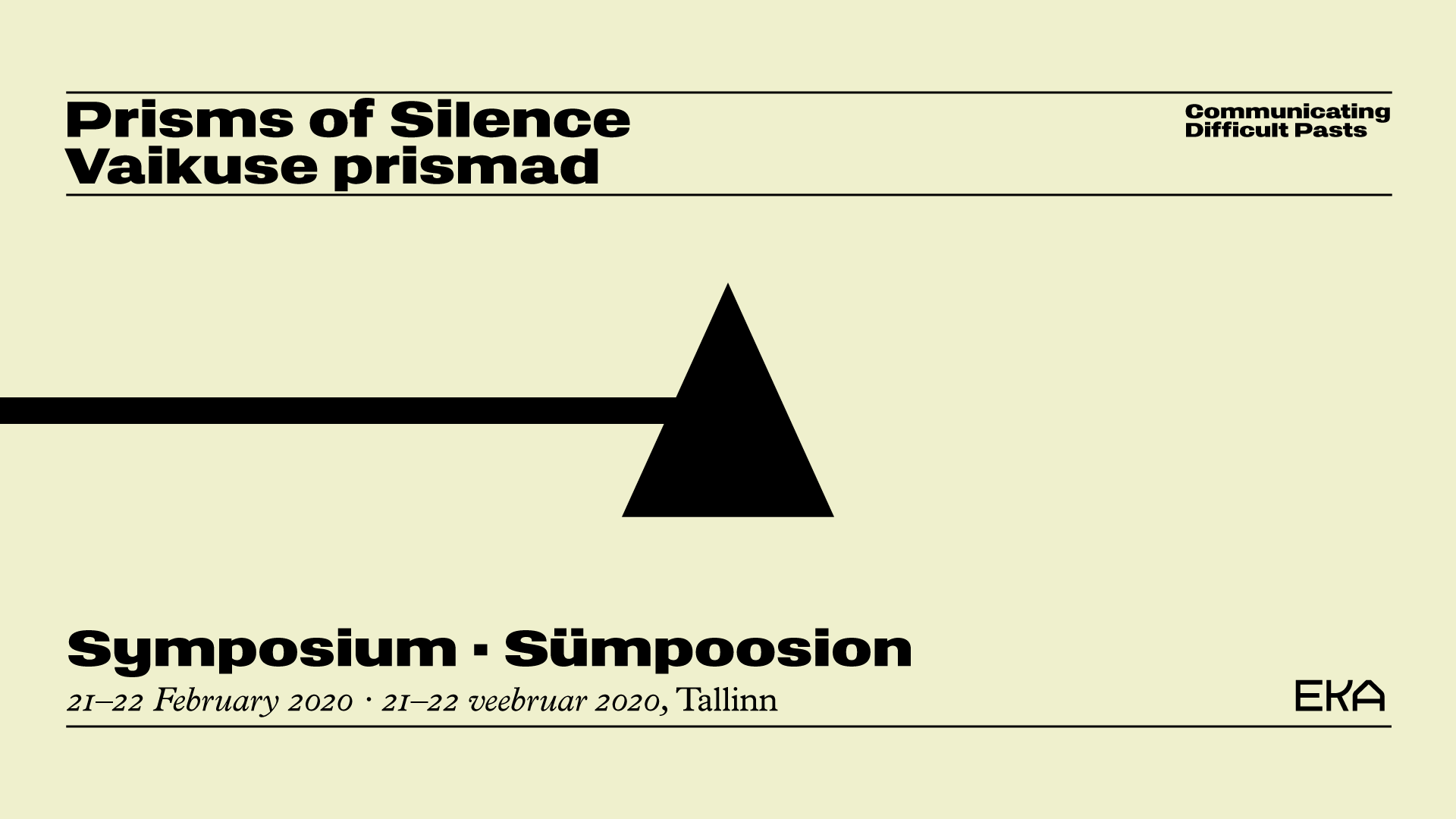
On February 21–22, 2020, the Estonian Academy of Arts will host an international symposium titled “Prisms of Silence”. The symposium seeks to analyse and understand the prisms through which we could meaningfully reconsider significant silences. A particular interest lies in rethinking the silences about WWII, its aftermath and the Soviet era in order to explore how they could offer productive ways of understanding present social change. The main organizers of the symposium are Dr Margaret Tali at the Institute of Art History and Visual Culture at the Estonian Academy of Arts, and Ieva Astahovska at the Latvian Centre for Contemporary Art. The symposium is a part of the collaborative project “Communicating Difficult Pasts” between the Institute of Art History and Visual Culture at EAA and the LCCA. The participants include humanities scholars, curators and artists: see the CFP.
“PRISMS OF SILENCE” SYMPOSIUM PROGRAM
Venue: Room A501, Estonian Academy of Arts,
Põhja puiestee 7, Tallinn
DAY 1: FRIDAY, 21 FEBRUARY 2020
9:00 – 9:10 Welcome by Mart Kalm, Rector of the Estonian Academy of Arts
9:10 – 9:30 Introduction to the Symposium by Margaret Tali and Ieva Astahovska
9:30 – 11:00 Session 1: Absences, their Impacts and Memory Work, Moderated by Violeta Davoliūtė, Vilnius University
Asja Mandić, Suppression of Socialist Narratives of the Second World War and its Modes of Visual Representation
Annika Toots, Exhibition Displaced Time: 10 Photographs from Restricted Collections as a Model of Remembrance
Jan Miklas-Frankowski, A City of Amnesia: Marcin Kącki’s Białystok. White Power. Black Memory
11:00 – 11:30 Coffee break
11:30 – 13:00 Session 2: Difficult Knowledge and Artistic Interventions, Moderated by Ieva Astahovska
Margaret Tali, Thinking through Silence and Mental Health in Recent Documentary Film
Zuzanna Hertzberg, Nomadic Memory: Artivism as Everyday Feminist Antifascist Practice
Rasa Goštautaitė, Contested Soviet Legacy: The Case of the Petras Cvirka Monument in Vilnius, Lithuania
13:00 – 14:00 Lunch break
14:30 – 16:00 Guided tour in the Vabamu Museum, Toompea 8 (1,5 h)
16:30 – 18:30 Session 3: When Sources Fail: Visual Languages for Analysing Past Trauma, Moderated by Margaret Tali
Assel Kadyrkhanova, Image, Sound, Absence, Silence. Artmaking on Historical Trauma
Lia Dostlieva, “I still feel sorry when I throw away food – Grandma used to tell me stories about the Holodomor.”
Kai Ziegner, A History of Violence
Aslan Goisum, Realms of Memory and Sources of Resistance
18:30 – 19:30 Dinner
9:30 – 10:15 Short keynote by Giedrė Jankevičiūtė, Reconstruction of Contested History: Vilnius, 1939-1949, Introduced by Margaret Tali
10:15 – 11:45 Session 4: The Unspeakable and Agency, Moderated by Eneken Laanes, Tallinn University
Katrina Black, Absence as Form: Spaces of Articulation in the Work of Chantal Akerman
Kati Roover, Project Red
Jaana Kokko, Oral History and Moving Image
11:45 – 12:15 Coffee break
12.15 – 13.45 Session 5: Patterns of Muting and Silencing, Moderated by Siobhan Kattago, University of Tartu
Franziska Link, Brawling Silences. Rereading Louis-Ferdinand Céline’s Écrits Maudits
Mischa Twitchin, Refracting Implication: The Uses of Silence
Jan Matonoha, Dispositives of Silence: Injurious Attachments and Discursive Emergence of Silencing; “Missing” Gender in Czech Dissent Samizdat and Exile Literature
13:45 – 14:45 Lunch break
14:45 – 16:15 Session 6: Breaking Silences and Challenges to Changing Discourses, Moderated by Ilya Lensky, Director of the Museum “Jews in Latvia”
Shelley Hornstein, Architecture’s Dirty Little Secrets
Ieva Astahovska, On Collaborations, Silences and Lustration
Maayan Raveh, The Implication of Silence – The Promised Land in Palestinian Christian Theology
16:15 – 16:45 Coffee break
16:45 – 18:15 Session 7: There and Not There – Ways of Giving Voice to the Past, Moderated by Pille Runnel, Head of Research at Estonian National Museum
Elina Niiranen, Finnish Linguist Pertti Virtaranta and Silenced Identity of Karelians in the 1960’s Soviet Karelia
Paulina Pukytė, Repetition of Silence
Elisabeth Kovtiak, (Non-)sites of Memory of the Holocaust in Belarus: Cases of Minsk and Brest
18:15 – 18:45 Final discussion and conclusions
19:00 – 20:00 Dinner
Supporters of the symposium:
EKA LOOVKÄRG – Eesti visuaal- ja ruumikultuuri õppe- ja
teaduskeskus (Sisutegevuste projekt)
2014-2020.4.01.16-0045
Nordic Culture Point
Cultural Endowment of Estonia
EKA research fund
NEP4DISSENT: COST Action 16213
International symposium “Prisms of Silence”
Friday 21 February, 2020 — Saturday 22 February, 2020
On February 21–22, 2020, the Estonian Academy of Arts will host an international symposium titled “Prisms of Silence”. The symposium seeks to analyse and understand the prisms through which we could meaningfully reconsider significant silences. A particular interest lies in rethinking the silences about WWII, its aftermath and the Soviet era in order to explore how they could offer productive ways of understanding present social change. The main organizers of the symposium are Dr Margaret Tali at the Institute of Art History and Visual Culture at the Estonian Academy of Arts, and Ieva Astahovska at the Latvian Centre for Contemporary Art. The symposium is a part of the collaborative project “Communicating Difficult Pasts” between the Institute of Art History and Visual Culture at EAA and the LCCA. The participants include humanities scholars, curators and artists: see the CFP.
“PRISMS OF SILENCE” SYMPOSIUM PROGRAM
Venue: Room A501, Estonian Academy of Arts,
Põhja puiestee 7, Tallinn
DAY 1: FRIDAY, 21 FEBRUARY 2020
9:00 – 9:10 Welcome by Mart Kalm, Rector of the Estonian Academy of Arts
9:10 – 9:30 Introduction to the Symposium by Margaret Tali and Ieva Astahovska
9:30 – 11:00 Session 1: Absences, their Impacts and Memory Work, Moderated by Violeta Davoliūtė, Vilnius University
Asja Mandić, Suppression of Socialist Narratives of the Second World War and its Modes of Visual Representation
Annika Toots, Exhibition Displaced Time: 10 Photographs from Restricted Collections as a Model of Remembrance
Jan Miklas-Frankowski, A City of Amnesia: Marcin Kącki’s Białystok. White Power. Black Memory
11:00 – 11:30 Coffee break
11:30 – 13:00 Session 2: Difficult Knowledge and Artistic Interventions, Moderated by Ieva Astahovska
Margaret Tali, Thinking through Silence and Mental Health in Recent Documentary Film
Zuzanna Hertzberg, Nomadic Memory: Artivism as Everyday Feminist Antifascist Practice
Rasa Goštautaitė, Contested Soviet Legacy: The Case of the Petras Cvirka Monument in Vilnius, Lithuania
13:00 – 14:00 Lunch break
14:30 – 16:00 Guided tour in the Vabamu Museum, Toompea 8 (1,5 h)
16:30 – 18:30 Session 3: When Sources Fail: Visual Languages for Analysing Past Trauma, Moderated by Margaret Tali
Assel Kadyrkhanova, Image, Sound, Absence, Silence. Artmaking on Historical Trauma
Lia Dostlieva, “I still feel sorry when I throw away food – Grandma used to tell me stories about the Holodomor.”
Kai Ziegner, A History of Violence
Aslan Goisum, Realms of Memory and Sources of Resistance
18:30 – 19:30 Dinner
9:30 – 10:15 Short keynote by Giedrė Jankevičiūtė, Reconstruction of Contested History: Vilnius, 1939-1949, Introduced by Margaret Tali
10:15 – 11:45 Session 4: The Unspeakable and Agency, Moderated by Eneken Laanes, Tallinn University
Katrina Black, Absence as Form: Spaces of Articulation in the Work of Chantal Akerman
Kati Roover, Project Red
Jaana Kokko, Oral History and Moving Image
11:45 – 12:15 Coffee break
12.15 – 13.45 Session 5: Patterns of Muting and Silencing, Moderated by Siobhan Kattago, University of Tartu
Franziska Link, Brawling Silences. Rereading Louis-Ferdinand Céline’s Écrits Maudits
Mischa Twitchin, Refracting Implication: The Uses of Silence
Jan Matonoha, Dispositives of Silence: Injurious Attachments and Discursive Emergence of Silencing; “Missing” Gender in Czech Dissent Samizdat and Exile Literature
13:45 – 14:45 Lunch break
14:45 – 16:15 Session 6: Breaking Silences and Challenges to Changing Discourses, Moderated by Ilya Lensky, Director of the Museum “Jews in Latvia”
Shelley Hornstein, Architecture’s Dirty Little Secrets
Ieva Astahovska, On Collaborations, Silences and Lustration
Maayan Raveh, The Implication of Silence – The Promised Land in Palestinian Christian Theology
16:15 – 16:45 Coffee break
16:45 – 18:15 Session 7: There and Not There – Ways of Giving Voice to the Past, Moderated by Pille Runnel, Head of Research at Estonian National Museum
Elina Niiranen, Finnish Linguist Pertti Virtaranta and Silenced Identity of Karelians in the 1960’s Soviet Karelia
Paulina Pukytė, Repetition of Silence
Elisabeth Kovtiak, (Non-)sites of Memory of the Holocaust in Belarus: Cases of Minsk and Brest
18:15 – 18:45 Final discussion and conclusions
19:00 – 20:00 Dinner
Supporters of the symposium:
EKA LOOVKÄRG – Eesti visuaal- ja ruumikultuuri õppe- ja
teaduskeskus (Sisutegevuste projekt)
2014-2020.4.01.16-0045
Nordic Culture Point
Cultural Endowment of Estonia
EKA research fund
NEP4DISSENT: COST Action 16213
13.02.2020
Open lecture on architecture: Secretary
The War of the Ants: Architectures of the MTV Generation
The EKA Faculty of Architecture Open Lecture Series spring semester will kick off on Thursday 13 February with Stockholm-based architecture practice Secretary which consists of architects Karin Matz and Rutger Sjögrim and theorist/urban planner Helen Runting. In a present where architecture will have to do without stable categories, clear periodizations, and an indisputable sense of purpose, architects have to multi-task, operating across a range of different registers simultaneously. In their lecture in Tallinn, Secretary will use their own work with interior design, video and spatial installation, research and urban design in order to self-critically reflect on the obsessions, compulsions, ambitions, and failures of a generation of architects that came of age in a world on the cusp of digitalization. How could architectural design and theory help us to understand and visualize our data-drenched present? How could we cut through all the white noise?
Architecture practice Secretary is built on a shared interest in the capacity of architecture to facilitate a dignified life at the scale of the population. Secretary aims to produce buildings, exhibitions, research studies, and megastructures that give form to the late welfare state in the 21st century.
The Faculty of Architecture of the Estonian Academy of Arts has curated the Open Lectures on Architecture series since 2012 – each year, a dozen architects, urbanists, both practicing as well as academics, introduce their work and field of research to the audience in Tallinn. All lectures are in English, free and open to everyone.
The series is funded by the Estonian Cultural Endowment.
Curators: Sille Pihlak, Johan Tali
www.avatudloengud.ee
www.facebook.com/EKAarhitektuur/
More info:
E-mail: arhitektuur@artun.ee
Tel. +372 642 0071
Open lecture on architecture: Secretary
Thursday 13 February, 2020
The War of the Ants: Architectures of the MTV Generation
The EKA Faculty of Architecture Open Lecture Series spring semester will kick off on Thursday 13 February with Stockholm-based architecture practice Secretary which consists of architects Karin Matz and Rutger Sjögrim and theorist/urban planner Helen Runting. In a present where architecture will have to do without stable categories, clear periodizations, and an indisputable sense of purpose, architects have to multi-task, operating across a range of different registers simultaneously. In their lecture in Tallinn, Secretary will use their own work with interior design, video and spatial installation, research and urban design in order to self-critically reflect on the obsessions, compulsions, ambitions, and failures of a generation of architects that came of age in a world on the cusp of digitalization. How could architectural design and theory help us to understand and visualize our data-drenched present? How could we cut through all the white noise?
Architecture practice Secretary is built on a shared interest in the capacity of architecture to facilitate a dignified life at the scale of the population. Secretary aims to produce buildings, exhibitions, research studies, and megastructures that give form to the late welfare state in the 21st century.
The Faculty of Architecture of the Estonian Academy of Arts has curated the Open Lectures on Architecture series since 2012 – each year, a dozen architects, urbanists, both practicing as well as academics, introduce their work and field of research to the audience in Tallinn. All lectures are in English, free and open to everyone.
The series is funded by the Estonian Cultural Endowment.
Curators: Sille Pihlak, Johan Tali
www.avatudloengud.ee
www.facebook.com/EKAarhitektuur/
More info:
E-mail: arhitektuur@artun.ee
Tel. +372 642 0071
31.01.2020
Open Lecture: Designer of New Balance Benjamin Moua on “Thoughtful Design”
Benjamin Moua is a NYC-based designer, maker, and creative who strives to strike a balance between form, function, and the engineering of ideas into products and experiences that people will trust and love. He has worked for major brands such as Reebok, Target, Adidas, Dick’s Sporting Goods, UNIQLO, Terramar Sports, New Balance and collaborated as a designer at the Boston Marathon, and the New York City Marathon.
His commitment to learning as both a professional and as a student, has allowed him the unique opportunity to stretch his interdisciplinary design experiences from Hardlines-to-Softlines goods, Color-to-Construction, Trend-to-Merchandising, and Print&Pattern-to-Production.
His uniquely expansive career, which started in fashion, has taken turns into consumable goods, high-performance protective gear, brand management, color theory/forecasting, and everything in between.
There are no projects too small or too big, and no questions left unturned, as he shares his insights on the key role designers serve as problem-solvers to the world’s unique creative challenges, and outlines why they are essential in addressing concepts such as ‘end-user experience’, ‘sustainability’, and ‘functional design’.
His lecture on the 31st January 2020 he will talk about identifying keys to success and will be a valuable experience for the students giving them insights and new perspectives in the world of design.
Lecture will be about an hour long with a Q&A session after giving the audience a chance to learn the secrets of global fashion and accessories industry.
Open Lecture: Designer of New Balance Benjamin Moua on “Thoughtful Design”
Friday 31 January, 2020
Benjamin Moua is a NYC-based designer, maker, and creative who strives to strike a balance between form, function, and the engineering of ideas into products and experiences that people will trust and love. He has worked for major brands such as Reebok, Target, Adidas, Dick’s Sporting Goods, UNIQLO, Terramar Sports, New Balance and collaborated as a designer at the Boston Marathon, and the New York City Marathon.
His commitment to learning as both a professional and as a student, has allowed him the unique opportunity to stretch his interdisciplinary design experiences from Hardlines-to-Softlines goods, Color-to-Construction, Trend-to-Merchandising, and Print&Pattern-to-Production.
His uniquely expansive career, which started in fashion, has taken turns into consumable goods, high-performance protective gear, brand management, color theory/forecasting, and everything in between.
There are no projects too small or too big, and no questions left unturned, as he shares his insights on the key role designers serve as problem-solvers to the world’s unique creative challenges, and outlines why they are essential in addressing concepts such as ‘end-user experience’, ‘sustainability’, and ‘functional design’.
His lecture on the 31st January 2020 he will talk about identifying keys to success and will be a valuable experience for the students giving them insights and new perspectives in the world of design.
Lecture will be about an hour long with a Q&A session after giving the audience a chance to learn the secrets of global fashion and accessories industry.